Showing posts with label natural history. Show all posts

Thursday, February 4, 2016

Loons of Eastern Washington

February 4, 2016

Jeff Heinlen has been studying loons throughout Okanogan County for years.  A magnificent bird of the north, famous for it calls echoing across northern lakes and considered by many to be a symbol of wilderness the Common Loon is a regular breeder in Okanogan County.  Join WDWF Wildlife Biologist Jeff Heinlen as he discusses the life history of this species and it’s management in Okanogan County.  

Tonight at 5:30 pm, homemade vegetarian French Onion Soup and Mazama Store Sea Salt Bagette at the lodge and Natural History Presentation at 6pm in the Ecology Center classroom.  $7/person.


Monday, January 25, 2016

Why Bears in the North Cascades?

January 25 
Join us on for a discussion about grizzly bears and the EIS process to potentially return these majestic animals to our own North Cascades Ecosystem.  Presentation is with Joe Scott of Conservation Northwest, and he will be joined by Scott Fitkin WDFW Biologist to answer additional questions.  

This Thursday, 5:30pm homemade soup and bread at the North Cascades Basecamp lodge, 6:00 presentation in the Classroom. Cost: $7/person.  255 Lost River Rd, Mazama.  509/996-2334.  info@northcascadesbasecamp.com


Monday, September 15, 2014

5th Annual Raptor Migration Festival

Raptor viewing in the Methow Valley spanned from Pateros to Mazama this weekend, during the 5th Annual Raptor Migration Festival.  Pateros to Chelan Ridge field day was hosted on Saturday Sept 14th by the Audubon Society of Northcentral Washington, and Harts Pass field day was hosted on Sunday, Sept 14th by the North Cascades Basecamp.  

It was an amazing day of sunshine, south winds, incredible viewscapes and great group of 30 enthusiastic birders.  Birders were welcomed at the Basecamp for a pancake birding breakfast, and then carpooled up to Harts Pass with Kent Woodruff as our birding guide.  The group casually observed 60 raptors throughout the day, including 22 sharp-shinned hawks,  7 merlins (one who caught and consumed a dragonfly on the wing), 4 goshawks, 4 prairie falcons, 3 golden eagles, 2 swainson's hawks, 1 broadwing hawk, 1 peregrine and many others...  The group also observed horned larks, American pipits, ravens and clarks nutcrackers.  
 
Kent helped beginner birders by discussing "shape and behavior" as the key components for raptor identification.  For our two similar sized and shaped accipiters, the shrug-shouldered and sharp square tail helped remember the sharp-shinned hawk, while the C-shaped curve in a Coopers hawk tail helps distinguish it from its smaller but overlapping sized cousin.
The warm summer -like weather, a steady wind, and full visability with no clouds on any horizon, was an ideal landscape for a day of birding.  The best advice given for the day, do not identify your bird til it is far in the distance; then your birdwatching friends can't disagree with your field ID when its gone.

Friday, August 22, 2014

Kids Art and Nature Camp- Garden Camp

Campers holding up their garden inspired banners
Chickens, snap peas and bunnies, oh my! We finished the last art and nature camp this past week at the North Cascades Basecamp, entitled Garden Camp. We had 13 kids join instructors Deirdre Cassidy, Kim Romain-Bondi and Raechel Youngberg. Our week kicked off with in-depth exploration of vegetable plants in the beautiful Basecamp garden. 

Amelia works on her carrot banner
Each kid completed a series of sketches in the garden focused on the garden plants and pollinators. The kids then drew a picture inspired by the garden, which they transformed into brightly colored garden banners. 
The wonderful intersection of art and nature did not end there. The kids used big luscious cabbage leaves gathered from the garden as a template for creating concrete birdbaths. The cabbage leaves left beautiful and intricate impressions onto the concrete. These birdbaths will be a wonderful addition to all the kids' home gardens or yards.
An unpainted birdbath
Later campers furthered their knowledge of garden plants while we practiced saving seeds. We smelled the calendula flowers while learning that it can be made into a salve to help treat rashes, as well as cuts and scrapes. We tasted spicy mizuna, a Japanese mustard green, that is a great addition to any salad. We crushed coriander pods in-between our fingers while inhaling its pungent aroma. The last seed we collected was swiss chard, a bright dark leafy green that can be transformed into a variety of dishes. 
Campers saving seeds
We also had the chance to hold baby chicks that have hatched in the garden within the last couple of weeks. It was a great opportunity for both human and feathered friends to become socialized with each other. We all enjoyed assisting the chicks with their perching practice by placing them on our shoulders and sometimes heads!
Emmet with his favorite chick, Pineapple.

Nichola with a perching chick

Lily familiarizing with chicks and their little sharp nails
We finished the week creating colorful designs with rocks, twigs, weeds, and other natural materials down near the river. Our designs were inspired by Andy Goldberg, an artist famous for transforming natural materials into awe-inspiring works of art. 
Evan showing off his mullenweed design 
Lilliana working on her concentric rock design
All in all we had a wonderful week here at the Basecamp exploring the garden, river, artistic endeavors, and friendships.   

Friday, August 15, 2014

Kids Nature and Art Camp- Flowers, Plants, Leaves and Trees

Campers with their finished mosaics
We had a beautiful botanical adventure-filled week at the North Cascades Basecamp with Native Flowers, Plants, Leaves and Trees Camp led by Deirdre Cassidy, Kim Romain-Bondi and Raechel Youngberg. The rain may have filled the sky for the better part of the week but we didn’t let it dampen our spirits!  We warmed up our creative juices with fun drawing classes led by Deirdre and Kim, and practiced our blind contour drawing with flowers and then faces to hilarious results.
Jessie with her blind contour drawing of her sister

We ventured outside for some fun in the Native Plant Restoration Garden where we completed a scavenger hunt to identify each plant and their medicinal/ethnobotany facts.  We also examined and sketched native flowers and leaves. 
Examining flowers for botanical illustrations
These flowers and leaves then became inspiration for individual mosaics,
Freya adds grout
which were the perfect art project for this week as they allowed us to stay dry inside the classroom, but with the barn doors opened up for fresh summer air.  The kids worked from designing their mosaic, to applying glass, grout, and finally wiping the whole thing clean for beautiful and colorful trivets to take home with them! 


Campers cleaning up their mosaic creations
The soggy weather didn’t stop us from playing camp games, climbing the play structure, or taking a stroll down to the river to look at rocks in the calm river bed.   What a fantastic group of campers and a great week of art and nature!
Freetime on the Basecamp play-structure
Happy campers outside during a sunburst

Friday, August 8, 2014

Kids Art and Nature Camp- Habitat Habitat!

We just finished our first Art and Nature Camp at the North Cascades Basecamp, titled Habitat, Habitat, Habitat.  We had 12 kids join Deirdre Cassidy, Kim Romain-Bondi, and Raechel Youngberg for a great week.  We started our week with nature walks and discussions of habitat, and native wildlife's adaptations to to live in Methow Valley.  Our sketch books came in handy as recorded our observations and created imaginary creatures with a random variety of adaptations, such as long claws, a shadow tail, big ears, round body, and a nut-cracking bill. The kids created incredible paper mache animals based on what we had learned, some with realistic features in the end, and others with folk art colors of their imagination.  Games in the grass and a fair amount of waterplay kept the days fun and cool.   The photo below shows our floating habitat we found in the swimming pond, where we identified 7 species of insects or animals that were using it.  We can't wait for next weeks camp- Native Plants, Trees, Flowers, and Leaves.
Raechel's lesson about how snakes are adapted to different habitats

Busy children were amazingly focused as they started their paper mache animals

Folk art color creations on Nella's snake
Kelley fox is ready for paint
Payten adds detail to her kingfisher masterpiece


Floating habitat in the swimming pond


Wednesday, March 26, 2014

Second Grade Field Trip

This winter we shipped the Methow Valley Elementary second grade class up to the North Cascades Basecamp for a field trip to learn about how animals adapt to winter.  There was a brief introduction in the Ecology Classroom, where Kim introduced myriad different kinds of adaptations, comparing and contrasting them to the methods that humans have developed to cope with the cold.  We all have the same needs to survive, and each creature has its own methods of achieving these basic survival essentials.

She talked about the warm coats humans wear for winter, whereas some animals grow new layers of fur, or hollow fur that traps more heat near the body, and compared our drying, canning, and preserving of foods to the caching that many animals do to keep fed through the sparse, snowy months.

After introducing the kids to the theme of the day, we split up into four groups, which rotated through different stations: The first was in the classroom working on some art projects and word games related to adaptations.  The kids then strapped on snowshoes and got to tromp around the forest surrounding the Basecamp looking for tracks and exploring different animal habitats with Kim and Steve.

Finally they were introduced to the world of subnivean creatures, who burrow under the snow and live in tunnels and dens in the low layer of snow near ground, where the snow provides insulation from the cold winter air and traps the animals' body heat around them.  Burrowing was something the kids could certainly relate to and they grabbed their "claws" (shovels) and got to work excavating the 4-8 foot snow piles around the warming hut with gusto.  We were even able to take some temperature readings in some of the burrows and compare them with the air temperature to see the effects of snow insulation.

Much fun was had by all, and, speaking for myself at least, we learned a lot about how many different ways there are to adapt to the harsh conditions we face.


Sunday, January 19, 2014

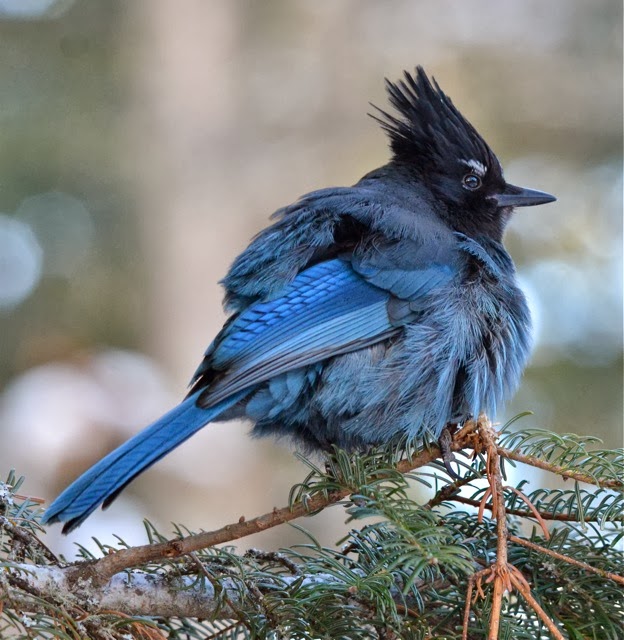
Steller Jay Communication and Research

You may have seen me lurking in your neighbors yard or driving up and down Hwy 20 in a Jeep with Montana plates. I'm not lost. I am a visiting PhD student from the University of Montana and I am here to study the Steller's jays of the Methow Valley

My research is focused on how animals communicate about danger and predators and a part of this is trying to figure out how Steller's jays combine two alarm calls and mimicry to encode information about predators.

I use a variety of playbacks to elicit different calls and behaviors at different bird feeders throughout the valley. The research is going well, although because of the mild winter the birds are less dependent on feeders and therefore a little more difficult to work with. However, the people, views and copious amounts of bakeries have eased that frustration. If you see me out and about, feel free to stop me and ask questions and I hope to see most of you at the talk summing up my research here on January 23rd.

Thanks for all of your help and support! 

Community Soup and Presentation:  
January 23, 2014.  Steller's Jay Communication by Alexis Billings, University of Montana PhD student - presentation at the North Cascades Basecamp in Mazama. 5:30pm soup dinner, 6:00pm presentation.  8$/person (bring a friend- $10 for 2). 

Friday, October 4, 2013

Restoring alpine vegetation in the Cascade mountains

 We kicked off a Treasured Landscapes Volunteer Vacation this summer with citizen scientists, National Forest Foundation's  (NFF) Kathleen Dowd-Gaily, the North Cascades Basecamp's Bondi family, and Therese Ohlson (retired USFS botanist) as they hiked the Maple Pass Loop to enjoy the wildflower display and learn about alpine ecology and restoration as part of a week long program to explore areas that are a part of the NFF’s Treasured Landscapes, Unforgettable Experiences conservation campaign.

The Maple Pass Loop is a great example of a trail being over-loved in our eastern Cascades mountains.  The views are incredible of Black Peak, Cutthroat Pass, Golden Horn to the north, and Glacier Peak to the south.  It is a strenuous but satisfying 8 mile round trip loop.  This beloved trail has earned its popularity with over 10,000 visitors /year (explained T. Ohlson), and it is written up in many of our North Cascades hiking guide books.  However its abraided trails through the mountain heather, the bare soil on every potential overlook, and the lack of vegetation at Maple Pass show its high volume use.


The US Forest Service and NFF are working to change over-loved trail with restoration of the alpine plant communities.  The Treasured Landscapes Initiative is collaborating its efforts with citizen science volunteers and forest service employees to designate a sound user path along the trail, plant and restore native plants outside the newly designated paths, and gently block off restored areas for future generations to enjoy.   The outcome will be incredible if folks respect the efforts and take charge of their actions on this and other trails above treeline.  A grand hope is that if this restoration effort is successful, it will lead to a greater understanding of how to love and protect our alpine trail systems.

If you'd like to be part of this effort, please contact Kathleen Dowd-Gailey by email at kdowdgailey@nationalforests.org or phone at 206/832-8280.  Or let us know if you'd like to partake in the project as part of a North Cascades Basecamp citizen science effort and we can help organize a summer project for 2015. 


Tuesday, September 17, 2013

Butterflies of the Cascades

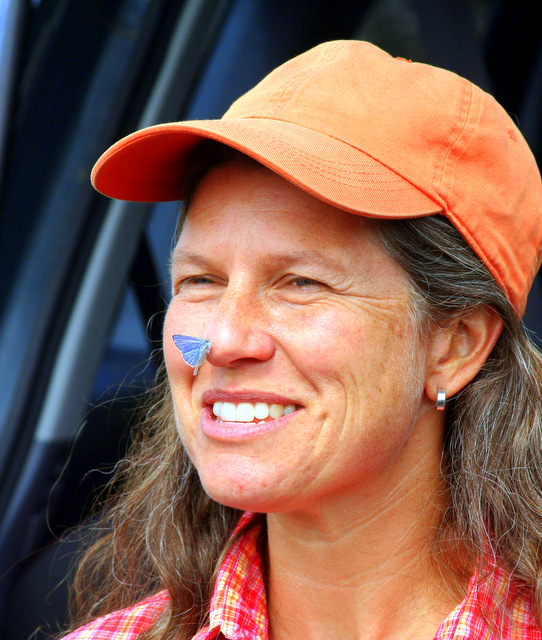
This August we hosted a fabulous retreat with Dr. Robert Michael Pyle, studying the Butterflies of the North Cascades.  Our crew for the weekend was enthusiastic, ready to learn, and ranged from the advanced lepidopteran in the field, to the laboratory researcher studying adaptations of butterflies, and onto those newly acquiring butterflying handling and identification skills.  Smiles and laughter ensued when Bob would post a release butterfly on one's nose.  What a great expression one makes when tickled by butterfly feet!

Here Bob demonstrates proper holding techniques for the group.  But sometimes they held still for us all on their own and photography was just as informative. We learned specifics such the life history of butterflies and their life stages, importance of nectaring and host plants for adult and caterpillars, and how to identify males and females.  Other discussions throughout the weekend were informative, in-depth, and focused on the bigger picture of global warming, nature deficit disorder, to collect or not to collect specimens for study, and impacts of changing habitats for butterflies in a shared world with humans. 

We look forward to hosting Bob in the future, and loved the inspiration of this amazing naturalist group! 
all three species of wood nymphs in one day!
butterflying around the Basecamp gardens to end the fun!