Showing posts with label school programs. Show all posts

Friday, August 8, 2014

Kids Art and Nature Camp- Habitat Habitat!

We just finished our first Art and Nature Camp at the North Cascades Basecamp, titled Habitat, Habitat, Habitat.  We had 12 kids join Deirdre Cassidy, Kim Romain-Bondi, and Raechel Youngberg for a great week.  We started our week with nature walks and discussions of habitat, and native wildlife's adaptations to to live in Methow Valley.  Our sketch books came in handy as recorded our observations and created imaginary creatures with a random variety of adaptations, such as long claws, a shadow tail, big ears, round body, and a nut-cracking bill. The kids created incredible paper mache animals based on what we had learned, some with realistic features in the end, and others with folk art colors of their imagination.  Games in the grass and a fair amount of waterplay kept the days fun and cool.   The photo below shows our floating habitat we found in the swimming pond, where we identified 7 species of insects or animals that were using it.  We can't wait for next weeks camp- Native Plants, Trees, Flowers, and Leaves.
Raechel's lesson about how snakes are adapted to different habitats

Busy children were amazingly focused as they started their paper mache animals

Folk art color creations on Nella's snake
Kelley fox is ready for paint
Payten adds detail to her kingfisher masterpiece


Floating habitat in the swimming pond


Wednesday, March 26, 2014

Second Grade Field Trip

This winter we shipped the Methow Valley Elementary second grade class up to the North Cascades Basecamp for a field trip to learn about how animals adapt to winter.  There was a brief introduction in the Ecology Classroom, where Kim introduced myriad different kinds of adaptations, comparing and contrasting them to the methods that humans have developed to cope with the cold.  We all have the same needs to survive, and each creature has its own methods of achieving these basic survival essentials.

She talked about the warm coats humans wear for winter, whereas some animals grow new layers of fur, or hollow fur that traps more heat near the body, and compared our drying, canning, and preserving of foods to the caching that many animals do to keep fed through the sparse, snowy months.

After introducing the kids to the theme of the day, we split up into four groups, which rotated through different stations: The first was in the classroom working on some art projects and word games related to adaptations.  The kids then strapped on snowshoes and got to tromp around the forest surrounding the Basecamp looking for tracks and exploring different animal habitats with Kim and Steve.

Finally they were introduced to the world of subnivean creatures, who burrow under the snow and live in tunnels and dens in the low layer of snow near ground, where the snow provides insulation from the cold winter air and traps the animals' body heat around them.  Burrowing was something the kids could certainly relate to and they grabbed their "claws" (shovels) and got to work excavating the 4-8 foot snow piles around the warming hut with gusto.  We were even able to take some temperature readings in some of the burrows and compare them with the air temperature to see the effects of snow insulation.

Much fun was had by all, and, speaking for myself at least, we learned a lot about how many different ways there are to adapt to the harsh conditions we face.


Sunday, June 23, 2013

Bats in Mazama

Last Friday, here at the North Cascades Basecamp, we hosted students from Central Washington University visiting as part of a wildlife ecology field techniques class with Dan Beck. Arriving in the early morning, Kim and Steve took the students on an introduction to birding walk around the Basecamp property where numerous species were heard and identified. 

Later in the evening, the students returned for a trip highlight- bat mist netting. What is bat mist netting you may ask (as I did).  Mist netting is an effective and safe way of capturing both birds and bats.   Very lightweight, almost invisible, nylon nets are strung between two poles over a highly trafficked area.  In our case, we strung three nets over ponds, very close to the water's surface.  
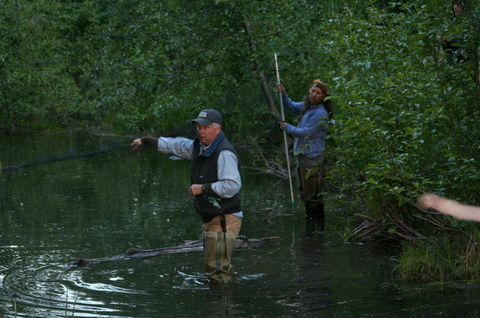
Kent and Kim carefully setting up the mist nets


USFWS Wildlife biologist, Kent Woodruff, led the evening and proved to be an excellent source of information.  However, early on he stated that bat knowledge is very limited, especially here in the Methow Valley.  "The answer to most questions about bats is 'I don't know.'"  He attributes the lack of knowledge to the difficult task of these small flying mammals, and to the lack of funding/support for research.  Unfortunately, bats often have a negative association in our society and aren't the cuddly animals that people are willing to support and protect.  While research and understanding surrounding bats is often limited, it is clear that they do play an important role in our ecosystem and are often referred to as a 'keystone' species.


Anticipation grew as the nets were assembled and dusk arrived.  The group of 25 students and Basecamp guests sat patiently and quietly on logs surrounding the ponds and waited for the bats to arrive.  Soon the first bats were spotted and excitement grew as more quickly arrived.  It was clear everyone was enjoying watching the acrobatic show the bats put on but also anxious for the first bat capture.


After 20 minutes of waiting, our patience was rewarded with the capture of the Methow Valley's smallest bat species.  Weighing about the same as a penny, California Mytois bat (myotis californicus) is found along the west coast of America; from British Columbia, Canada to as far south as Guatemala.
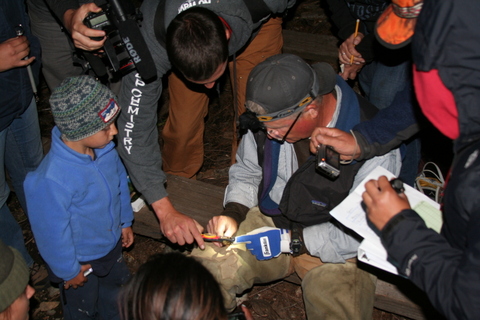


The group assembled around Kent as he identified the bat.  He identified our bat by it’s keeled calcar (a cartilaginous spur of the ankle joint that extends toward the tail), small feet, color and facial features.
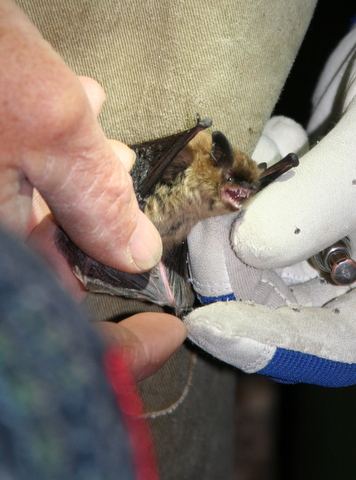

Pointing out the Keeled Calcar


There are approximately 1100 bat species across every continent (except Antarctica). Here in Washington State we have 15 bats species, 8 of which are currently listed federally as Category 2 Candidates, meaning adequate information is lacking to list them as endangered species. However, it is hypothesized that they should receive that designation.  Across the nation approximately 40 percent of bat species are currently threatened.  


How can you help?

Interested in learning more about Bats in Washington?
Basic facts about bats from the Washington Department of Fish and Wildlife


The recent (and first!) conservation plan for bats in Washington State


Washington Department of Fish and Wildlife Live Bat Cam


Bats Northwest; a non-profit to protect bats through education and research

Thursday, May 16, 2013

Methow Valley Elementary School Field Trips

Methow Valley Elementary School kids spent the last month studying science here at the North Cascades Basecamp.  2nd graders spent 2 field days studying ecosystems and the 'Life of a Log', while the 3rd graders spent another 2 field days studying plant growth and development in nature.  We all had a blast, school teachers, chaparones, science leaders, and 50 kids per day walking in the woods, studying nature in depth, and performing and teaching to their fellow peers all about what they learned.

Here are a few photo highlights from 2nd grade studying Ecosystems:  
team building a log ecosystem

learning the life of the down log


learning out of doors

magnifying an insect


studying the root ball
presenting with staff in hand
team building exercises
what does it taste like?


riparian ecosystem studies
 ___________________________________________________________________
Photo highlights from 3rd grade field trip studying Plant Growth and Development:
studying the parts of a flower

magnifying the stamen

graphing tree age and diameter
counting tree rings


growth of a tree
making cordage from cedar

graphing creations
a walk across the bridge in the forest

drinking fir needle tea