Join us on for a discussion about grizzly bears and the EIS process to potentially return these majestic animals to our own North Cascades Ecosystem. Presentation is with Joe Scott of Conservation Northwest, and he will be joined by Scott Fitkin WDFW Biologist to answer additional questions.
The North Cascades Basecamp's blogsite to inspire and cultivate connections to the natural world through conservation, art, education, and field study programs.
Showing posts with label workshops. Show all posts
Monday, January 25, 2016
Why Bears in the North Cascades?
January 25
Join us on for a discussion about grizzly bears and the EIS process to potentially return these majestic animals to our own North Cascades Ecosystem. Presentation is with Joe Scott of Conservation Northwest, and he will be joined by Scott Fitkin WDFW Biologist to answer additional questions.
Sunday, January 3, 2016
Thursday Community Soup and Presentation Series
Its that time of the year again! We are looking forward to another great season of natural history lectures and good soup and company at the North Cascades Basecamp this winter! Please join us for the following:
Jan 14, Beaver Project- 10 Year Update, with Kent
Woodruff, USFS.
Jan 21, Campfire, Song and Drum Circle, Celeste and Kip Roberts.
Jan 28, Why Grizzly
Bears in the North Cascades, Joe Scott, Conservation Northwest.
Feb 4, Loons of Eastern Washington, Jeff
Heinlen, WDFW.
Feb 11, Wolf Predation in Livestock Occupied Areas of Washington State, Gabe Spence, WSU.
Details: Each of these Thursdays at 5:30pm we'll be serving homemade soup and bread at the lodge. At 6:00pm will begin our natural history presentation in the Ecology Center Classroom. Call or email with any questions.
255 Lost River Rd, Mazama. 509-996-2334. Cost: $7/person.
Monday, September 15, 2014
5th Annual Raptor Migration Festival
Raptor viewing in the Methow Valley spanned from Pateros to Mazama this weekend, during the 5th Annual Raptor Migration Festival. Pateros to Chelan Ridge field day was hosted on Saturday Sept 14th by the Audubon Society of Northcentral Washington, and Harts Pass field day was hosted on Sunday, Sept 14th by the North Cascades Basecamp.
It was an amazing day of sunshine, south winds, incredible viewscapes and great group of 30 enthusiastic birders. Birders were welcomed at the Basecamp for a pancake birding breakfast, and then carpooled up to Harts Pass with Kent Woodruff as our birding guide. The group casually observed 60 raptors throughout the day, including 22 sharp-shinned hawks, 7 merlins (one who caught and consumed a dragonfly on the wing), 4 goshawks, 4 prairie falcons, 3 golden eagles, 2 swainson's hawks, 1 broadwing hawk, 1 peregrine and many others... The group also observed horned larks, American pipits, ravens and clarks nutcrackers.
Kent helped beginner birders by discussing "shape and behavior" as the key components for raptor identification. For our two similar sized and shaped accipiters, the shrug-shouldered and sharp square tail helped remember the sharp-shinned hawk, while the C-shaped curve in a Coopers hawk tail helps distinguish it from its smaller but overlapping sized cousin.
The warm summer -like weather, a steady
wind, and full visability with no clouds on any horizon, was an ideal landscape
for a day of birding. The best advice given for the day, do not identify your
bird til it is far in the distance; then your birdwatching friends can't
disagree with your field ID when its gone.
Friday, August 8, 2014
Kids Art and Nature Camp- Habitat Habitat!
We just finished our first Art and Nature Camp at the North Cascades Basecamp, titled Habitat, Habitat, Habitat. We had 12 kids join Deirdre Cassidy, Kim Romain-Bondi, and Raechel Youngberg for a great week. We started our week with nature walks and discussions of habitat, and native wildlife's adaptations to to live in Methow Valley. Our sketch books came in handy as recorded our observations and created imaginary creatures with a random variety of adaptations, such as long claws, a shadow tail, big ears, round body, and a nut-cracking bill. The kids created incredible paper mache animals based on what we had learned, some with realistic features in the end, and others with folk art colors of their imagination. Games in the grass and a fair amount of waterplay kept the days fun and cool. The photo below shows our floating habitat we found in the swimming pond, where we identified 7 species of insects or animals that were using it. We can't wait for next weeks camp- Native Plants, Trees, Flowers, and Leaves.
| Raechel's lesson about how snakes are adapted to different habitats |
| Busy children were amazingly focused as they started their paper mache animals |
| Folk art color creations on Nella's snake |
| Kelley fox is ready for paint |
| Payten adds detail to her kingfisher masterpiece |
| Floating habitat in the swimming pond |
Friday, October 4, 2013
Restoring alpine vegetation in the Cascade mountains
If you'd like to be part of this effort, please contact Kathleen Dowd-Gailey by email at kdowdgailey@nationalforests.org or phone at 206/832-8280. Or let us know if you'd like to partake in the project as part of a North Cascades Basecamp citizen science effort and we can help organize a summer project for 2015.
Tuesday, September 17, 2013
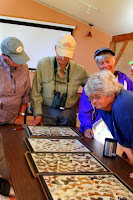
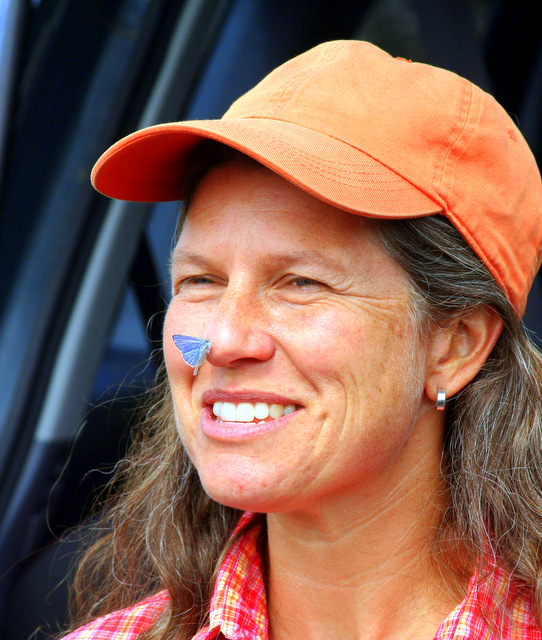
Butterflies of the Cascades
We look forward to hosting Bob in the future, and loved the inspiration of this amazing naturalist group!
| all three species of wood nymphs in one day! |
| butterflying around the Basecamp gardens to end the fun! |
Wednesday, February 20, 2013
Bald Eagle Surveys- Winter Foraging
Last Sunday, January 27th, the North Cascades Basecamp lead
another successful wintering bald eagle survey in the valley. After spotting
our first eagle, a 1st year juvenile, within minutes of meeting at
the Barn in Winthrop, we took off. This winter, there seems to be fewer eagles
in the Winthrop to Mazama area than last year. This is likely due to a small to minimal run of steelhead migrating back to the hatchery this winter, which differs from last January/February. It also could be the result of a minimal deer mortality, since the deer have easy access to food this year; With hard winter years, there are more deer mortalities and therefore increased food resources for these scavengers. Another theory is that deeper snow in the Winthrop area during the winter pushes the eagles down-valley, looking for more food and foraging opportunities. Regardless, we took off
south to find eagles.
We began to spot bald eagles along the East Country Road near Twisp where the cows are calving, leaving the fields littered with placentas, a nutritious
meal for a bald eagle. There was
also an unidentified carcass (most likely a deer) in the field, which also
attracted attention from eagles, ravens, and crows. In total, we saw 17 bald eagles
at this site. Several were perched in cottonwoods around the field’s
perimeter, while others feasted on the carcass. There was a nice array of
juveniles at the field. The group got great views of 1st, 2nd,
and 3rd year olds, allowing us to see the progression in plumage,
beak, and eye color.
| An adult bald eagle watches over a carcass. If you look close you can see the blood on it's face! |
As we continued south along East 20 and 153, we saw 7 more eagles
perched in trees near the river. We finally pulled over and
discovered one of the night roosts the eagles are using this winter. From
4:45PM – 5:10PM we saw 22 birds fly in to the area to spend the night. We saw
12 of these eagles (6 adults and 6 juveniles) fly to into a portion of the night roost right
off the road. As they perched, they noisily communicated with each
other. We also saw 8 eagles head up a valley about 200 meters further south.
These eagles were most likely headed to a different night roost, although we
lost sight of them behind a hill, and do not know where exactly they ended up.
We are excited to find out in upcoming surveys!
Want to join us next time? We are heading out again on February 10th and 24th,1-5:30pm; cost is $20/person.
Email info@northcascadesbasecamp.com,
or call (509)996-2334 for more information.
Thursday, January 24, 2013
Wintering Bald Eagle Surveys in the Methow Valley
This winter,
naturalists are braving the cold temperatures while joining the North Cascades
Basecamp to survey bald eagle distribution and night roosting locations in the mid
to upper Methow Valley. On January
13th, five intrepid
explorers documented 11 eagles between Twisp and Carlton, three of which were
spotted as they were flying into their evening roost. One highlight included an
up-close view of several perched juveniles eagles, likely feasting on prey near
the river below, as their beaks were covered with blood.
![]() |
One-year bald eagle juvenile near Carlton.
Notice the blood on its beak! |
As the group is
observing and documenting bald eagles and their locations, they are also
becoming skilled at aging these slow to mature birds. Observers expected one of
the eagles to be a first-year bird (born in 2012) as it’s head was dark brown,
beak had very little yellow on it, and its eyes were still dark brown. At two years of age, bald eagles have
more yellow developing on their beak, lighter brown eyes, a lighter golden
brown head, some white mottling on their chest, and a fair amount of white on
the underside of their wings. At three years, they have further lightened
heads, beak, and eyes, as well as a dark brown stripe behind their eyes. A
four-year juvenile resembles a mature adult, except for some minimal brown
speckling on their head and tail. Other highlights of the surveys include great views of an
adult golden eagle, two red tail hawks, and two rough-legged hawks near Twisp.
![]() |
| Three-year old bald eagle juvenile with white on top of head and dark stripe behind the eye. |
If you’d like to learn more about
bald eagles and join these surveys with the North Cascades Basecamp, surveys
are every other Sunday between 1-5:30pm; cost is $20/person. Email info@northcascadesbasecamp.com,
or call (509)996-2334 for more information.
Saturday, January 19, 2013
Winter Wildlife Tracking
On Saturday morning, a determined group of eight gathered near the cozy fire in the North Cascades Basecamp Lodge. We listened as our animal tracking guide, Gabe Spence, described his experience learning about tracks, following animals footprints in all environments, and how we would do just that here in the Methow.
| The group examines our first track sighting |
As we embarked into the snowy landscape in Mazama, the conditions proved perfect for tracking. The sun was shining, the snow was soft, the temperature cold enough (as in 3 degrees...brrr!) to have preserved every movement of the animals over the last 3 days.
![]() |
| Gabe identifying tracks |
With Gabe’s help, the group quickly spotted tracks with two large imprints in front and two smaller and offset imprints behind. The medium sized animal must hop given the distance between the tracks, and since frogs are out of the season, we decided on the snowshoe hare.
| Snow shoe hare track |
These quick and industrious hares seem to do well in this environment as we saw their tracks on many occasions. The low hanging trees provide fir needles, buds and twig snacks for their seasonal diet. Deer, whose tracks we also found close by in the forest, also devour similar woody treats during the winter season.
Not only were we able to identify animal tracks, but many of the prints in the snow told the story behind the animal’s movement. Our investigations found motivation behind an animal’s directional movements and the speed of their gait. As one member of the group said, “we are like detectives, using clues to tell us what happened!”
| The group following coyote tracks near Beaver Pond |
Before returning for lunch, we followed tracks we initially believed to be one coyote. Our group carefully walked alongside the prints and eventually recognized that three coyotes were tracking lunch of their own
The coyotes’ footprints led us to a tree where we found another animal’s tracks and remains of their lunch: pine cone remnants. Clearly, the coyotes were hoping to feast on unsuspecting red squirrels. The coyotes’ movements through the trees harboring squirrels explained their thinking and know-how to find their prey.
After warming our cold toes by the fire and a hearty lunch at the Basecamp, we drove to another site in Mazama where Gabe frequently spots cougars. Though we did not find cougar evidence on this day, we found many tracks that would likely be a cougar feast. Deer, weasel, field mice, and coyote tracks lay preserved for examination.
![]() |
| Small tracks hurried for shelter in the snow |
We finished our tracking day by following a deer. Deer tracks are usually clearly identifiable but can be tricky depending on the snow conditions. Their long, thin legs and heavy bodies leave connected strides forming a squared off trough in the deep snow where many deer have walked.
In the deep now, deer, much like snow shoers, will generally follow one another, staying in the tracks already laid by another thus saving time and energy. In the deep powder snow, it was difficult to determine the direction of travel since last week’s snow most often fell into the tracks, obscuring the actual footprint. After much discussion, we learned from Gabe that in these conditions, the leading pointed edge of the hoof where the track is deeper indicates the direction the deer traveled.
| The group after a fun day following tracks! |
It was with trepidation that many members of the group took off gloves to put their hand into the snow of the deep track. They found out which direction the deer was walking, exposing their fingers to the frigid temperatures. We continued following the tracks which eventually led us to our parked cars. The deer must have known we were all chilly after an exciting day in the great outdoors.
Wednesday, January 9, 2013
The New Ecology Center Classroom!
When the Roberts family owned the Basecamp, Dick built a workshop as a place to finish projects of his own and focus on his varied interests. Several years ago, Kim and Steve happily realized the many opportunities the space provides, and thus, a new project was born at Basecamp.
![]() |
| Even Mica the dog tried to get in on the action |
Andy demonstrating the
proper grouting technique
|
![]() |
| New skill: mixing colors for plaster |
![]() | ||||||
| Dan helped us lay tiles and Methow River Rocks |
| Swirls of tile started the mosaic |
Kim and Steve led the group in problem solving throughout the entire experience, and the flooring was no different. With some help from friends and neighbors, and the drive for completion, the classroom was finished just in time for Susan Prichard's presentation on native insects of the Methow Valley on last Thursday!
| Thursday's group gathered for Susan's presentation |
With
the lighting dimmed for her slideshow, it felt so satisfying to see
lecturing and learning happening in the refinished Classroom.
Here's to much more learning, and laughter all year long.
Happy New Years!
Monday, October 22, 2012
Painting Watercolors of Autumn
We celebrated the colors of the autumn season this October with John Adams, NW Watercolorist, at the North Cascades Basecamp. A full house of artists partook in a weekend workshop learning techniques for composition, texture and value, color mixing, and putting those vibrant golds, oranges, reds, and yellows into action in a fall landscape. Johns demonstrations were invaluable in the painting and crafting process. The diversity in the group from age to skill level came together as an enjoyable weekend for all.
Subscribe to:
Posts (Atom)