Showing posts with label spring. Show all posts

Sunday, June 23, 2013

Bats in Mazama

Last Friday, here at the North Cascades Basecamp, we hosted students from Central Washington University visiting as part of a wildlife ecology field techniques class with Dan Beck. Arriving in the early morning, Kim and Steve took the students on an introduction to birding walk around the Basecamp property where numerous species were heard and identified. 

Later in the evening, the students returned for a trip highlight- bat mist netting. What is bat mist netting you may ask (as I did).  Mist netting is an effective and safe way of capturing both birds and bats.   Very lightweight, almost invisible, nylon nets are strung between two poles over a highly trafficked area.  In our case, we strung three nets over ponds, very close to the water's surface.  
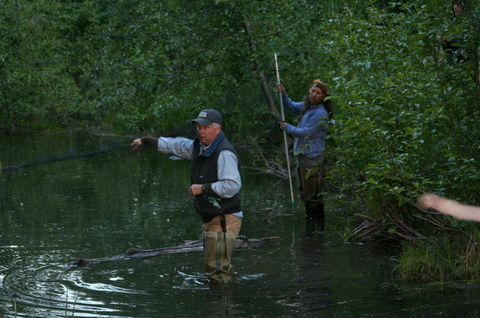
Kent and Kim carefully setting up the mist nets


USFWS Wildlife biologist, Kent Woodruff, led the evening and proved to be an excellent source of information.  However, early on he stated that bat knowledge is very limited, especially here in the Methow Valley.  "The answer to most questions about bats is 'I don't know.'"  He attributes the lack of knowledge to the difficult task of these small flying mammals, and to the lack of funding/support for research.  Unfortunately, bats often have a negative association in our society and aren't the cuddly animals that people are willing to support and protect.  While research and understanding surrounding bats is often limited, it is clear that they do play an important role in our ecosystem and are often referred to as a 'keystone' species.


Anticipation grew as the nets were assembled and dusk arrived.  The group of 25 students and Basecamp guests sat patiently and quietly on logs surrounding the ponds and waited for the bats to arrive.  Soon the first bats were spotted and excitement grew as more quickly arrived.  It was clear everyone was enjoying watching the acrobatic show the bats put on but also anxious for the first bat capture.


After 20 minutes of waiting, our patience was rewarded with the capture of the Methow Valley's smallest bat species.  Weighing about the same as a penny, California Mytois bat (myotis californicus) is found along the west coast of America; from British Columbia, Canada to as far south as Guatemala.
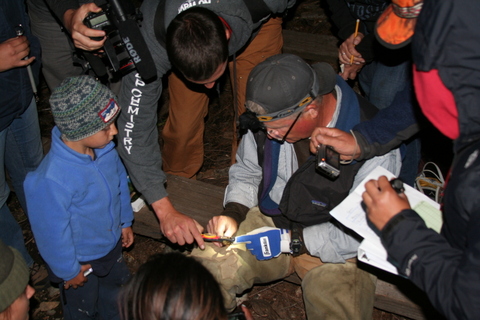


The group assembled around Kent as he identified the bat.  He identified our bat by it’s keeled calcar (a cartilaginous spur of the ankle joint that extends toward the tail), small feet, color and facial features.
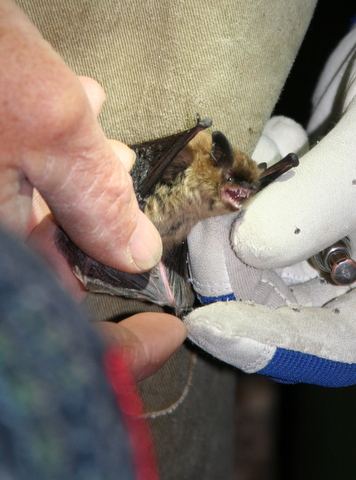

Pointing out the Keeled Calcar


There are approximately 1100 bat species across every continent (except Antarctica). Here in Washington State we have 15 bats species, 8 of which are currently listed federally as Category 2 Candidates, meaning adequate information is lacking to list them as endangered species. However, it is hypothesized that they should receive that designation.  Across the nation approximately 40 percent of bat species are currently threatened.  


How can you help?

Interested in learning more about Bats in Washington?
Basic facts about bats from the Washington Department of Fish and Wildlife


The recent (and first!) conservation plan for bats in Washington State


Washington Department of Fish and Wildlife Live Bat Cam


Bats Northwest; a non-profit to protect bats through education and research

Wednesday, June 19, 2013

Co-evolution of the red-naped and red-breasted sapsuckers


The red-breasted Sphyrapicus ruber and red-naped Sphyrapicus nuchalis sapsuckers are two woodpecker species that overlap in their range near the crest of the Cascades.  These two species are sympatric, meaning that during the evolution process, they became two new species while inhabiting the same geographic region. Generally speaking in Washington, the red-breasted live on the west side, the red-naped on the east side.   At the North Cascades Basecamp in Mazama, we’ve had the opportunity to observe both species in a cedar and birch grove that is unique to the upper Methow watershed.

This year, a male red-breasted sapsucker was observed late in the winter along the Basecamp trail.  He drummed his broken drum on local snags, showed off his beautiful red head, called his quiet “mewing” call, and even excavated a perfectly round cavity in a birch snag.  A female red-naped sapsucker was often seen in the same area, licking (not drinking) up sap with her barbed tongue, making frequent visits to his territory, and exploring the newly constructed cavity with intrepidation (poking her head up to the entrance but not entering).  Finally in mid-June, after many hours of observation, we saw the red-breasted male and the red-naped female both enter and exist the nesting cavity with food in beak for the hungry nestlings, and he was being a good dad and dropping fecal sacs to the ground as his housecleaning duties ensued.   

These two species of sapsuckers are known to hybridize in south-central Oregon, northeastern California, along the California-Nevada border, and in southern Nevada.  Genetic studies by Johnson et al (1983, 1985) showed that red-naped and red-breasted sapsuckers have the highest avian genetic relatedness ever reported, similar to that found between avian subspecies.  They also found the hybrid F1 generation to produce viable offspring, although it seems that certain F2 backcrossings may have partial sterility issues.  These studies and others confirm that although these two species are nearly genetically identical, there is a low degree of hybridization while encountering each other regularly, and therefore they are still considered as separate biological species. 

It will be interesting to see what our new fledgling hybrid sapsuckers look like, and who they choose as mates into the future.


Ned K. Johnson and Robert M. Zink. 1983. Speciation in Sapsuckers (Sphyrapicus): I. Genetic Differentiation.  The Auk: 871-884.


Ned K. Johnson and Carla Bowman Johnson.  1985.  Speciation in Sapsuckers (Sphyrapicus): II. Sympatry, Hybridization, and Mate Preference in S. ruber daggetti and S. nuchalis.  The Auk: 1-15.
 

Thursday, May 16, 2013

Birding extravaganza at the Basecamp - May 16th!

A birding morning by the birch forest today was amazing- especially the red-breasted sapsucker!  And here is proof- we believe it is a male, who is coming and going from a newly excavated cavity in a birch snag.  Even more exciting is the female red-napped sapsucker in the area, who is visiting the cavity and poking her head inside while the red-breasted is inside... but not entering. 


Here are the birds Steve and I encountered this morning:  7:30-9:00am, partially sunny, cooler temps than last week, and the height of breeding song here in Mazama. 

Townsend's warblers
Wilson's warblers
Yellow-rumped warblers
Nashville warblers
Pacific wren (AKA winter wren)
House wren
Cassin's vireo
Warbling vireo
Varied thrush
Hammond's flycatcher
Black-chinned hummingbird
Caliope's hummingbird
Red-napped sapsucker
Red-breasted sapsucker
Golden-crowned kinglets
American robin
American crow
Raven


Friday, July 27, 2012

Calliope's Hummingbird Chicks Have Fledged!


July 19th- The chicks are eighteen days old today and after having been gone for two days I was excited to see the presence of flight feathers. Over their head and back they are that brown w/red tipped color, but also have a greenish tinge now. The feathers on their wings are longer and black, there are also solid white feathers toward the back of their wings and tail. Their little beaks are mostly black now with some yellow at the base. Their chins are solid white in color.

July 20th-  I checked on the chicks right before a thunderstorm hit Mazama and the Basecamp. The chicks were sitting close together. There was generally no change in their appearance between day 18 and 19.

July 21st- The chicks are twenty days old today, the number of days predicted for a Calliope's hummingbird to fledge.. which sure enough was right on! I checked on them this morning to find that they had survived the wind and rain of the storm in the protected foliage of the forest. Both chicks woke up when I arrived, they also appeared to be much greener in color. I took a few pictures, and as I turned to leaved both chicks flew out of the nest. I was able to turn around and see one of them fly up into a neighboring tree!


Monday, July 16, 2012

Hummingbird Update!

 Remember these tiny little Calliope's hummingbird hatchlings? 


Thursday July 12th, 2012
Today the first hatched chick is twelve days old, and the second chick is eleven days old. The chicks are much larger, and definitely fill up the whole nest. Their feathers are short, even in length and distribution. The feathers are dark brown with white tips. Their orange beaks have elongated but are not as long as a mature hummingbird's. They were nestled in the nest facing the same direction, and breathing very fast but probably normal for a hummingbird.

Sunday July 15th, 2012
Today the chicks are fifteen and fourteen days old. The weather is dynamic today, with some thunder, wind, and sun. Amazingly, the big leaf maple branch that is carrying the hummingbird nest is very reliable, the chicks do not seemed phased. The chicks eyes were open for the first time in my observations which was awesome to see, they are looking around and blinking a lot, also drifting in and out of sleep. Their beaks have definitely developed into longer (approx. 1.5 cm), thinner, and stronger beaks. The beak coloring is now red/orange at the base with yellow edges; the tip is black.

As far as feather coloring and texture goes, the chicks have short, white, feathers on their chins and also slightly above the beak. From the top of their head and covering their back the feathers are a mixture of some solid white feathers and some brown feathers with reddish tips. These feathers are short and smooth and even in length. They are less evenly distributed than the previous observation. They also still have light brown downy feathers that stick up along their backs. These chicks should fledge in about five days!


Wednesday, July 4, 2012

Calliope Hummingbirds- Daily observations on a mother and her chicks!


On Friday June 29th at eleven a.m. Amelia, Emmet, Kim, Mica and I walked down the trail to the river a short ways to a hummingbird nest that Amelia had found earlier in the day. Carefully assembled on a thin, drooping, leafy branch about six feet above the ground was the tiny nest. It was a small and cup shaped, about five inches in length. Hummingbird nests are made by the female from materials like cotton from cottonwood trees strewn together by spiderwebs which is really cool. On top of the nest the female arranges lichen, possibly for camouflage. When we came to the nest the mom hummingbird was sitting on it. As we took a step closer she flew away with the typical whirring noise that hummingbirds make. Now we were able to look inside the nest to find that there were two, tiny, white, elliptical shaped eggs! Hummingbirds lay about two eggs 1-3 days apart. Amelia had seen only one egg the day before so the second one must have been laid today.

Two days later on Sunday July 1st one of the chicks hatched! This time Amelia, Emmet and I took a ladder to the area and waited until the mom flew away so we could easily peek into the nest. Amelia was the first to see the baby hummingbird and was so excited. Sure enough, when Emmet and I looked we found a little purplish colored chick with a few crumpled feathers sticking out.


The next afternoon on Monday July 2nd, Kim and I took our cameras down to photograph the chick but the mom stayed on the nest the whole time so we tried not to disturb her and left. Around seven p.m. Amelia and I tried to see the chicks one more time and this time the mom wasn't on the nest! We set up our ladder to look into the nest and found two chicks. The babies had their eyes closed and still only a few feathers. I took a picture of them and the broken egg shells left over in the nest. Later that night we brought Steve and Emmet down to see the chicks too.

On Tuesday July 3rd, day three for the first hatchling and day two for the second, the mom was sitting on the nest when I arrived to see them. She flew away though and I was able to see the chicks. Today both of them were moving their bodies and heads while opening their short orange beaks too! Their eyes also appeared larger and rounder today. I left shortly after looking at them so the mom could come back as soon as possible.

Facts about Calliope Hummingbirds:


  • Scientific Name: Stellula calliope. The Calliope Hummingbird is distinct enough to have its own genera.
  • Habitat: Coniferous mountains, meadows, forested hillsides
  • Breeding Season: Mid-May to August, they are single-brooded.
  • Eggs: Usually 2 elliptical or sub elliptical, white, 12x8 mm eggs.
  • Incubation: Only the female incubates and later cares for her offspring. Incubation usually lasts 15-18 days. 
  • Nestling: Altricial
  • Nestling period: Brooded and fed regurgitated nectar for 11-12 days. Fed arthropods delivered by the female until they reach 21-23 days when they will become fledglings. 
  • Conservation: Little is known about many hummingbird populations because they are difficult to study. The only species thought to be in decline may be the Rufous Hummingbird due to some habitat loss. Habitat loss in Mexico and Central America is a potential threat to hummingbirds. 
  • Hummingbird Fun Fact: A hummingbirds heart rate is 1250 beats per minute while in flight!
Works Cited:
Sibley, David. The Sibley Guide to Birds. New York: Alfred A. Knopf, 2000. Print.

Thursday, June 7, 2012

Spring Festival: Celebrating Birds and Botany in the Methow Valley

Last weekend  was the 2nd Annual Spring Festival where we welcomed the birds back to the Methow Valley and danced amongst the flowers of spring in Mazama.  The weekend was full of field trips with birders and botanists alike.  This included an early morning bird walk starting at 6am with Steve Bondi, birding by ear with Libby Shriner and Victor Glick, birding and botanizing with Dana Visalli and Joe Arnett, wildflower walk with Eric Burr, and a riparian bird walk with Howard Ferguson and Scott Fitkin.  Presentations focused on the interactions between plants and birds and their co-evolution together over the millenia.


Saturday's festival activities included the Native Plant Society's booth naming all the crazy human-made, natural, and weed plant items that make up birds' nests as we picked our way through 10 nests from different species.  The most unique items were the snakeskin and spider webs, straw wrappers, bailing twine, and plastics woven into the nests. The owl pellet station kept kids and adults busy, identifying and gluing small mammal parts onto a black piece of paper for a final take home project.  Bruce helped us make basketry woven nests from serviceberry boughs, wool, dried grass, bark and leaves.  The Audubon Society station had life-sized and hand-painted birds positioned in their respective habitats, with field guides and binoculars for easy identification.  And lastly, the Community School Kids invited everyone to be a bird and migrate south in a game that helped learn the hazards and benefits of long-distance migrations.  Lastly, Okanogan Wildlife League Lisa Lyndsay stood with live raptors on-hand, showing off Pigwigeon the screech owl, a sweet-tempered great horned owl, a stubborn red-tailed hawk, and dizzy the kestral.

The day of activities was topped off by Sam Lucy and Linda Robertson's poetry reading at noon, where everyone was taken back by their grace and inspiring words of spring!


Wednesday, June 6, 2012

Art and Science In Nature


A group of enthusiastic artists~naturalists spent a weekend with Hannah Hinchman and Bruce Thompson, studying ecology and the art of nature journaling.   We studied the myriad of flowers in the shrub-steppe landscape, the wildlife diversity of wetland pond systems, and the circle of kingdoms in the Douglas fir forest. We also studied the art of journaling- how to record what you see, use pictures and words to create an event map, and how to use observation to answer ecological questions.  


Conversation, artistic talents, and laughter was shared easily within the group, and introspective time studying by oneself as well as learning as a group completed a fulfilling weekend of art and ecology

Hannah's feedback for the weekend was, "this is the best basecamp I've encountered as a venue for a workshop~ warm, beautiful, and the major attraction of having you two as devoted local experts".  Thank you Hannah for the kind words.  It was as fun for us as it was for the workshop participants!


Friday, June 1, 2012

New Chick

We had a new baby chick hatch today!  Broody Mama Leghorn is a great mama thus far.  Not too protective, not too docile.  She willingly adopted our friend's fertitilized eggs we gave her to sit on, since we have no roosters at this time.  Hopefully we get a full clutch of 7 chicks out from under her.

Tuesday, May 8, 2012

Spring in the Methow

What a glorious time of the year.  Spring is really in the air.  Bluebird skies & new wildflower blooms greeting us daily, parading across the landscape.  We camped at Pipestone Canyon the other night to soak in the beauty and watch the full moon.  Yet another season of exploration.

Sunday, August 21, 2011

New Chicks

 We have a new set of chicks here at the Basecamp this summer, and we've been having fun watching them grow.  They are now 6 weeks old, and integrating well into the flock of 1 1/2 yr old hens we already have.  We had a beautiful Barred Rock rooster (hence the 6 black&white chicks) who graciously gave DNA to all our hens, however none of them wanted to sit on eggs.  So without a hen willing to do the job, we borrowed "Broody Mama" from our friends the Bard family in Twisp.  She willingly took our dozen fertilized eggs, sat on them for the exact 21 days, and successfully hatched eight chicks.  As a mother, she takes her job very seriously protecting her chicks and letting them forage first on the array of leftovers from Basecamp guests and the family garden harvest.  Hopefully we'll get hens out of the batch of chicks;  too young to know yet.  All eggs from our girls go into our meals here at the Basecamp, and we love that orange color and bold flavor you don't get from store-bought eggs.

Thursday, April 28, 2011

Home for the Birds

The Methow Valley Community School 3-4th graders were at the Basecamp for their outdoor education day and helped hang songbird-sized birdhouses throughout the upper portion of the property.  We decided not to put any in the lower wetland and cedar grove areas because there is so much habitat already available to our cavity nesters. The true need was on the grounds near our infrastructure.  We took note to hang the boxes on trees where disturbance is minimal, they can be seen easily from the hot tub, cabin and lodge breakfast areas, and adjacent to our home/garden.  We placed them on the south to east side of the trees where the sunshine can warm their cold little bodies early in the mornings on these still so chilly nights.