If you'd like to be part of this effort, please contact Kathleen Dowd-Gailey by email at kdowdgailey@nationalforests.org or phone at 206/832-8280. Or let us know if you'd like to partake in the project as part of a North Cascades Basecamp citizen science effort and we can help organize a summer project for 2015.
The North Cascades Basecamp's blogsite to inspire and cultivate connections to the natural world through conservation, art, education, and field study programs.
Friday, October 4, 2013
Restoring alpine vegetation in the Cascade mountains
If you'd like to be part of this effort, please contact Kathleen Dowd-Gailey by email at kdowdgailey@nationalforests.org or phone at 206/832-8280. Or let us know if you'd like to partake in the project as part of a North Cascades Basecamp citizen science effort and we can help organize a summer project for 2015.
Wednesday, October 2, 2013
Basecamp Granola
INGREDIENTS
DRY
4 cups rolled oats
1 cup raw almonds (chunked)
1 cup raw walnuts
1 cup raw sunflower seeds
1 cup raw sesame seeds
4 T ground flax
3 tsp ground cinnamon
1 tsp sea salt
WET
1/2 cup honey (substitute partial 100% maple syrup or brown rice syrup)
3 T agave nectar
3 T coconut oil
1/4 cup canola oil
1/4 cup peanut butter
1 1/4 cup brown sugar
ADD INS:
coconut flakes, dried cranberries, pepitas, raisins
DIRECTIONS
Set oven to 100 degrees F. In a medium saucepan, head the wet ingredients until smooth. Stir frequently so it doesn't burn. Stir wet ingredients into dry until well coated; it may be hard to stir at this point, but make sure everything is combined. Spread mixture onto a well oiled jelly roll sheet, or other baking pan with at least a 1/2 inch side. Bake for 45 minutes, removing the pan every 15 minute to give the granola a good stir and prevent over browning on the sides. Allow to cool on the pan before putting it away in a airtight container.
Printed from North Cascades Basecamp recipe blog
www.northcascadesbasecamp.com
October 2013
inspired by Oh She Glows My Favourite Homemade Granola (to-date)
Tuesday, September 17, 2013
Butterflies of the Cascades
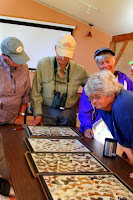
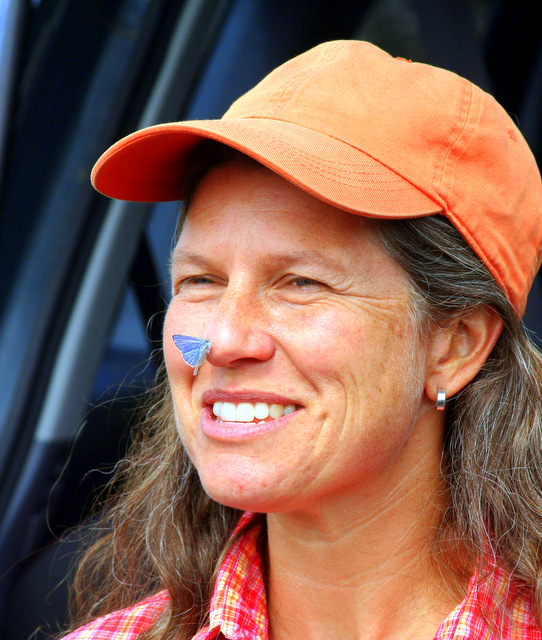
We look forward to hosting Bob in the future, and loved the inspiration of this amazing naturalist group!
| all three species of wood nymphs in one day! |
| butterflying around the Basecamp gardens to end the fun! |
Raptor Migration
The Fourth Annual Raptor Migration Festival fulfilled expectations this year with great
raptor viewing from Chelan Ridge to Harts
Pass. The North Cascades Basecamp was proud to be
involved with a booth at Pateros Memorial
Park. A crowd of 30 joined us at the Basecamp on
Saturday night for summer garden vegetable curry soup and emmer brownies with ice cream
dessert, followed by a great presentation by Andy Stepniewski of Yakima Audubon.
Andy and Ellen led 15+ participants up to Harts
Pass on Sunday morning to watch
more of the migration magic. The sunny
ridgeline was ideal on this day for migrating raptors; wings set back, head
thrust forward, and hardly a flap needed except for the balancing act to
overcompensate for gusts of wind reaching 20-30 mph. The highlight of the day was acrobatic
prairie falcons at the Slate Peak
parking area, numerous osprey riding the winds, and rocket-fast merlins chasing
pipets. We watched over 50 birds in
their migration south, catching those thermals and riding the gusty winds. Happy travels and we’ll see you next
year!
Saturday, July 20, 2013
Our Growing Garden
The summer sun, heat, and long days have arrived in Mazama. Our garden is loving this weather and is literally growing by the inch everyday! Our peas and raspberries are producing a large harvest daily and it seems the cucumbers and squash grow noticeably larger by the hour. We harvested our garlic scapes a few weeks ago (see our pesto recipe below) and are anxious to see how big the garlic is this year!
Here's a list of some of the things currently growing in our garden; Veggies and fruits; arugula, apples, beans, broccoli, carrots, cabbage, cherries, cucumbers, garlic, hops, kale, lettuce, nasturtiums, potatoes, snow and sugar snap peas, radishes, squash, onions, raspberries, rhubarb, strawberries, spinach, tomatoes,eggplant, zuchini and yellow squash.
Herbs; calendula, cilantro, dill, parsley, oregano, basil, chives, mint, catnip, lavender,
With hot summer days here, it is often hard to imagine the cold winter days ahead. However, we are already thinking ahead to winter, when our garden is resting and we depend on all the food we've stored away during this time of plenty. Much of our garden bounty goes straight to the table, feeding our family and lodge guest. The rest is processed and kept stored away- jams, pesto, salsa and such are canned; garlic, onions, carrots, potatoes are kept in dry storage; greens and berries go to the freezer. Happy harvest to all!
HONEY RASPBERRY JAM
3 cups raspberries
1 1/2 cups honey
Mash berries in sauce pan. Heat to a boil and cook down for 15 minutes. Add the honey and bring to just above boiling. Cook for 5 minutes. Remove from heat and beat with a wire whip for about 6 minutes. Spoon into hot jars, leave 1/4 inch head-space. Process in a boiling water bath for 10 minutes. Enjoy!
6-7 garlic scapes
1/4 cup pumpkin seeds
1/2 cup olive oil
1 tsp salt
1/2 cup Parmesan cheese
Blend in a food processor til smooth and creamy.
Use fresh or jar it up in the freezer for a cold winters night treat.
Sunday, June 23, 2013
Bats in Mazama
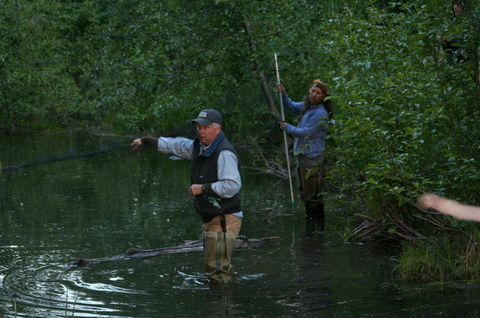
Last Friday, here at the North Cascades Basecamp, we hosted students from Central Washington University visiting as part of a wildlife ecology field techniques class with Dan Beck. Arriving in the early morning, Kim and Steve took the students on an introduction to birding walk around the Basecamp property where numerous species were heard and identified. Later in the evening, the students returned for a trip highlight- bat mist netting. What is bat mist netting you may ask (as I did). Mist netting is an effective and safe way of capturing both birds and bats. Very lightweight, almost invisible, nylon nets are strung between two poles over a highly trafficked area. In our case, we strung three nets over ponds, very close to the water's surface.
Kent and Kim carefully setting up the mist nets
USFWS Wildlife biologist, Kent Woodruff, led the evening and proved to be an excellent source of information. However, early on he stated that bat knowledge is very limited, especially here in the Methow Valley. "The answer to most questions about bats is 'I don't know.'" He attributes the lack of knowledge to the difficult task of these small flying mammals, and to the lack of funding/support for research. Unfortunately, bats often have a negative association in our society and aren't the cuddly animals that people are willing to support and protect. While research and understanding surrounding bats is often limited, it is clear that they do play an
important role in our ecosystem and are often referred to as a 'keystone' species.
Anticipation grew as the nets were assembled and dusk arrived. The group of 25 students and Basecamp guests sat patiently and quietly on logs surrounding the ponds and waited for the bats to arrive. Soon the first bats were spotted and excitement grew as more quickly arrived. It was clear everyone was enjoying watching the acrobatic show the bats put on but also anxious for the first bat capture.
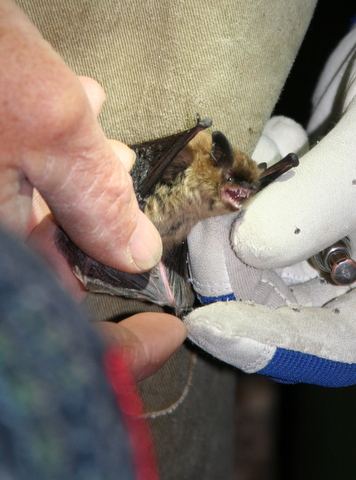
After 20 minutes of waiting, our patience was rewarded with the capture of the Methow Valley's smallest bat species. Weighing about the same as a penny, California Mytois bat
(myotis californicus) is found along the west coast of America; from British Columbia, Canada to as far south as Guatemala.
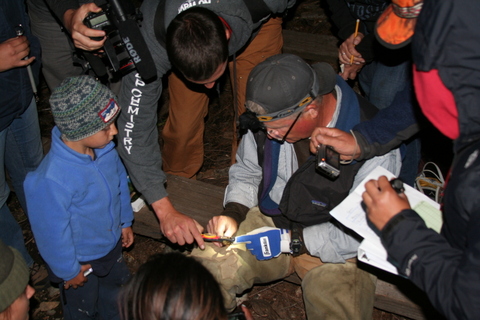
The group assembled around Kent as he identified the bat. He identified our bat by it’s keeled calcar (a cartilaginous spur of the ankle joint that extends toward the tail), small feet, color and facial features.
Pointing out the Keeled Calcar
There are approximately 1100 bat species across every continent (except Antarctica). Here in Washington State we have 15 bats species, 8 of which are currently listed federally as Category 2 Candidates, meaning adequate information is lacking to list them as endangered species. However, it is hypothesized that they should receive that designation. Across the nation approximately 40 percent of bat species are currently threatened.
How can you help?
- Support bat conservation and research organizations;
- Help increase bat habitat;
- Put up bat houses (http://batcon.org/index.php/get-involved/install-a-bat-house.html)
- Leave hollow trees and snags intact
- Do not disturb roosting or hibernating bats
- Minimize pesticide use
Interested in learning more about Bats in Washington?
Basic facts about bats from the Washington Department of Fish and Wildlife
The recent (and first!) conservation plan for bats in Washington State
Washington Department of Fish and Wildlife Live Bat Cam
Bats Northwest; a non-profit to protect bats through education and research
Wednesday, June 19, 2013
Co-evolution of the red-naped and red-breasted sapsuckers
The red-breasted Sphyrapicus
ruber and red-naped Sphyrapicus
nuchalis sapsuckers are two woodpecker species that overlap in their range
near the crest of the Cascades. These two
species are sympatric, meaning that during the evolution process, they became
two new species while inhabiting the same geographic region. Generally
speaking in Washington, the
red-breasted live on the west side, the red-naped on the east side. At the North Cascades Basecamp in Mazama,
we’ve had the opportunity to observe both species in a cedar and birch grove
that is unique to the upper Methow watershed.
This year, a male red-breasted sapsucker was observed late
in the winter along the Basecamp trail.
He drummed his broken drum on local snags, showed off his beautiful red
head, called his quiet “mewing” call, and even excavated a perfectly round
cavity in a birch snag. A female
red-naped sapsucker was often seen in the same area, licking (not drinking) up
sap with her barbed tongue, making frequent visits to his territory, and
exploring the newly constructed cavity with intrepidation (poking her head up
to the entrance but not entering). Finally
in mid-June, after many hours of observation, we saw the red-breasted male and
the red-naped female both enter and exist the nesting cavity with food in beak
for the hungry nestlings, and he was being a good dad and dropping fecal sacs
to the ground as his housecleaning duties ensued.
These two species of sapsuckers are known to hybridize in
south-central Oregon,
northeastern California, along
the California-Nevada border, and in southern Nevada. Genetic studies by Johnson et al (1983, 1985)
showed that red-naped and red-breasted sapsuckers have the highest avian
genetic relatedness ever reported, similar to that found between avian
subspecies. They also found the hybrid
F1 generation to produce viable offspring, although it seems that certain F2 backcrossings
may have partial sterility issues. These studies and others confirm that
although these two species are nearly genetically identical, there is a low
degree of hybridization while encountering each other regularly, and
therefore they are still considered as separate biological species.
It will be interesting to see what our new fledgling hybrid
sapsuckers look like, and who they choose as mates into the future.
Ned K. Johnson and Robert M. Zink. 1983. Speciation in
Sapsuckers (Sphyrapicus): I. Genetic Differentiation. The Auk: 871-884.
Ned K. Johnson and Carla Bowman Johnson. 1985. Speciation in Sapsuckers (Sphyrapicus): II.
Sympatry, Hybridization, and Mate Preference in S. ruber daggetti and S. nuchalis. The Auk: 1-15.
Subscribe to:
Posts (Atom)